Archive for 2011

Happy Holidays!

Posted by on Dec 25 2011 | Design, Thoughts

Christmas Day is already here and we’re going to enjoy the day relaxing, eating yummy food with family. Hopefully you are/will be doing the same with your family, friends and loved ones! Before we head off to the festivities, we thought we’d quickly throw together a Christmas design for the occasion. What do you think? Like? Don’t like?

Christmas 2011 graphic

Merry Christmas, everyone!
- Julia and Tania. : o) : o).

no comments for now

Our Favourite iPad Productivity Apps

Posted by on Nov 28 2011 | Creative Writing, Internet, Technology

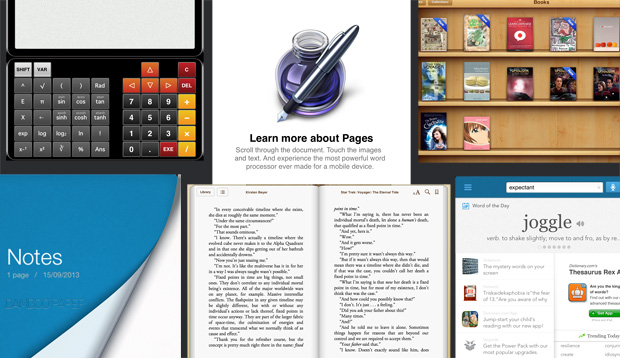
We love productivity apps. They make life so much easier and more convenient. A few days ago we downloaded one from iTunes called Wacom Bamboo Paper and last week we downloaded an awesome calculator for the iPad. We were so pleased with our finds that we decided that this latest blog will be dedicated to naming several of our most favourite Apple iTunes apps.


1. Wacom Bamboo Paper
This is a notebook you can use to scribble down your notes, lists, diagrams and drawings. When you don’t feel like typing, you can use your finger or iPad stylus to write or draw. The pages in the notebook comes in blank, lined or grid—perfect for all kinds of note keeping: whether it be an idea, a shopping list, or graph at a math lecture. We like the convenience of this app. Often, during times of idleness, ideas pop in; it is usually when there is no pen or paper in sight. With this iPad app, story and design ideas can be jotted down or drawn without the need to search out for a pen, paper or turn on the light. So handy!


2. Pages
Pages on the iPad is a fantastic application for creating documents on the go. This application isn’t as feature-filled as the program we’re used to using—Microsoft Word—but it has enough features to get a story, article, letter or CV typed up. With this app, we can have all the common formatting applied to the text (bolds, alignments, indenting, columns and line height) to produce a very good looking, well-presented document. When everything is done, it can be printed via an AirPrint printer. Since we don’t have an AirPrint printer, we often like to save it as a Word document and then send it to iTunes on our PC and get it printed that way.


3. WordPress
When we’re away from the desktop, we update our blog through the WordPress app. This app works with both self-hosted and hosted blogs; and once you set up access, you can switch between all your blogs if you run multiple blogs with a simple click.

    One thing we have noticed is that if you use any special entities in your blog posts (for example ‘&’ or ‘—’) it doesn’t like these in the form of &amp or &ndash (respectively), but prefers decimal entities (& or –). So be wary of that when using special character entities in your blog posts when using this app to publish.

    Another reason to use this app whilst on the iPad is that there seems to be a problem with typing up a blog entry using the Safari browser. The problem we encountered was not being able to scroll down in the text box where you type up the blog. This meant that when we get to the end of the text box, any text that was outside the area of the text box was hidden; so the WordPress app is needed.


4. CalculatorLab
We’ve been looking for a good calculator that did a little more than a basic add-and-subtract, multiply-and-divide equation. We were looking for something that allowed input of parenthesis, squares, cubes, like a scientific calculator. We finally found one that not only had everythingwe were looking for, but it is also well-designed, free and displayed multiple lines. This calculator is more than we could ask for a free calculator app!


5. iBooks
This app is awesome. We just love the design of it. We love that you can display books in the bookshelf view or as a list. You are able to change the paper colour to white or sepia as well as the font the text is displayed in. This app can be a great way to learn new vocabulary, too. When you read a book in this app and find a word you don’t understand, you can tap the word and use iBook’s dictionary to find its meaning. Is that cool or what?


6. Dictionary
The Dictionary app is created by the people at Dictionary.com. We love this site and often visit it whenever we want to find the meaning to a word or look up a synonym on their online thesaurus. Now, we don’t have to visit their site, we can look up words in the dictionary and the thesaurus included in this app. What’s more, we don’t have to have an Internet connection to access the words. This is very handy for people who love to find new words or synonyms to use in their writing. The features that do require an Internet connection is when you wish to listen the word’s pronunciation or check out the “Word of the Day” which the app offers.


    So there we have it. The above six are our favourite apps on iPad. You may have noticed that a lot of them are related to writing in some way. This is because we mainly use the iPad for writing and blogging (and when we’re not writing, we use the device to play games : oP : oP). If you like to write, you might like to try some of these apps to help you jot down ideas quickly, write and read some of your favourite books with. Don’t forget about to check out the CalculatorLab app: that has nothing to do with writing, but you never know when you might need it to calculate something—like the cost of a shopping list of books and stationery for your writing endeavours. : oP : oP.

no comments for now

Macarons, Quest for Perfection – Technique, Macaronnage

Posted by on Oct 25 2011 | Macarons, Quest for Perfection, Special Features

Making Macarons: What Recipes Don't Tell You

Make perfect macarons with our new eBook, Making Macarons: What Recipes Don’t Tell You


We’re back with our third installment to our Macarons, Quest for Perfection blog series: Technique, Macaronnage.

Just in case we have some readers who are looking to make macarons for the first time, and are looking for information to what this particular step is, we will explain what Macaronnage is. Macaronnage is the stage where you mix the ground almonds/icing sugar mixture with the egg white foam. Getting this technique right is important; so it’s worthwhile to practice and understand how to do this correctly and get the right consistency.

    We are going to mention three methods in this post, but they are not the only ways to achieve the right consistency of the batter. We have also chosen to write about the following three methods to illustrate that this stage does not require it to be a delicate process—in fact, you don’t want to be too delicate: you actually want to knock out some air so you can obtain the right consistency as well as avoid potential air pockets during baking.

    The first method is to fold the ground almonds/icing sugar mixture (from now on, we’ll just refer to this mixture as ‘GA/IS mixture’ for ease of typing : oP : oP) into the egg whites in multiple additions: you divide the GA/IS mixture into three to six parts; add each part to the egg white foam, reasonably incorporating each part. Once combined, fold, rotate the bowl and fold again. Continue in this manner until the right consistency is achieved.

    The second method is similar to the first method except for the way you get the batter to the right consistency. With this method, you add the GA/IS mixture to the egg white foam, incorporate roughly (through folding) then press down on the batter until you get the right consistency. The way you do the last part is bring your spatula to the bottom of the bowl in the centre, press down and drag up against the side of the bowl (this technique is known as the macaronner). Rotate the bowl and press and drag 2 – 3 more times. Gather the batter back into the centre and repeat the pressing down technique until the right consistency is reached. With this method you can add the GA/IS mixture in parts or all at once.

    The third method utilises the score-and-fold method. Add the entire GA/IS mixture into the egg white foam. Take the spatula and score through the egg white foam three or four times (like you’re drawing an asterix in the bowl), then fold until you get to the right consistency. This method isn’t as popularly used, but it works. It also shows that you can be sort of rough with the egg white foam and still it’ll all be okay.

    If you’re wondering which method we prefer, it is the second method where we fold roughly then press down on the batter. We like this method because the process is fast and the ingredients get incorporated well. Whenever we need to add colour, we can add it during or after the whipping of the egg whites and the colour will still get incorporated without streaks.

    Below, are a couple of images of the technique we use, of how we macaronner:


    A couple more notes about the macaronnage: when adding the ground almond/icing sugar mixture onto the egg white foam, you may want to scatter lightly instead of pouring it onto the foam. There are people who just dump it in and it seems to work for them, but we suggest not doing this to prevent deflating it too much initially and ending up with the wrong consistency at the end.


The Correct Consistency – Ways to Test When the Batter is Done

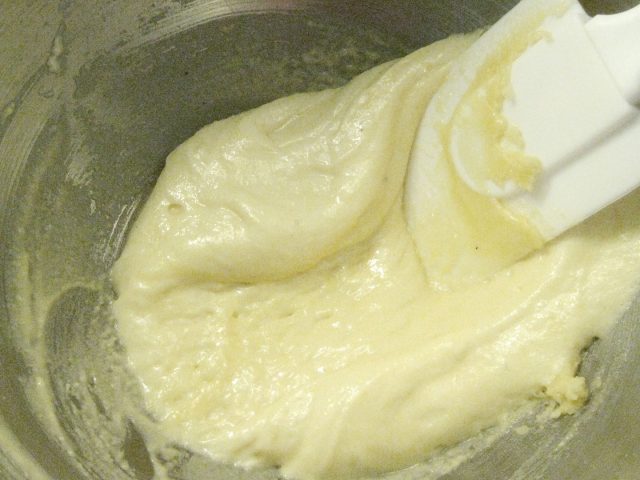
Thus far, we’ve been referring to the right consistency a lot without saying what the right consistency is, so we shall try to enlighten. The right consistency is when the batter in your bowl resembles a shiny thickshake. When you pick the batter up with a spatula and let it fall back into the bowl, a ribbon forms and slowly gathers in a pile below. The speed at which the batter falls down to the bowl of batter is gingerly or relaxedly; it isn’t at all speedy.

    The best way to judge if you’ve got the right consistency is to count the number of seconds it takes to settle back down into the batter. This is the most reliable way we have found. It has never failed us. The time it takes for that ribbon of batter to sink back into the batter in the bowl is around 30 seconds: watch one portion of the ribbon making contact with the bowl of batter below. Start counting. By the time you reach 30 seconds, that portion of the ribbon should have sunken back into the batter, only a faint outline of it is visible by this time. This is a good indication that after the batter is piped, the peaks will slowly sink back and give you flat tops and remain beautiful and sturdy disks.


We use the ribbon test. Here, we begin to keep an eye on a section of the ribbon and initiate the 30 second count. We are keeping an eye on the section of ribbon labelled ‘FL’.

This is around 15 seconds. Also notice and compare the spread of the batter on the left-hand side where we have scooped batter up from. Notice the slow expansion with each image.

This is around 25 seconds and the section looks to be good as the section is sinking back into the batter with only a faint line visible. The batter has expanded more.


This is 30 seconds. The batter has slowed down in spreading out and the line has remained faint. There is only a small bit of ribbon still to sink back into the batter. This is the consistency the macaron batter should be.

A clearer picture of the ribbon can be seen here as we pour the macaron batter into the piping bag. The macaron batter is a nice, thick, flowing, continuous ribbon.

The ribbon folding and piling neatly and perfectly in the piping bag. It looks exactly like a ribbon!


    An alternative way to test consistency is to do a test pipe. You can grab a plate and place a dollop of batter on it. If it flattens down, spread a bit and still hold its shape, the batter is ready.

    A number of recipes gives directions on the number of strokes or folds for the macaronnage. This method of telling when the batter is done is not only inflexible, but can be detrimental than helpful because it doesn’t account for someone’s individual folding style (longer/shorter strokes, heavy-/light-handed, faster/slower folding action). The number of folds/strokes is a good guide when starting out, but spotting the correct look and consistency of the macaron batter, understanding the look and consistency through practice, will benefit in the long run and will allow one to increase/decrease the batch size, to add different gel or liquid colouring and/or flavours to the recipe or change to a whole new recipe without needing to recalculate the number of folds to suit the changes. Treat the direction in recipes that use this method as a guide. Don’t rely on that information too much. Rather, train your eyes on spotting the perfect batter look and consistency.


Comparisons: Perfect, Over- and Under-mixed Batter

Perfect

We find that good batter has the look and consistency of a thickshake—the glossy and thick look. When the batter is in the piping bag and you have the bag vertical to the tray with no pressure applied, batter peek and flow out of the nozzle by itself, but it is at a (slow) speed that it still gives you time to position your piping bag before piping. This is not a sign of an over-mixed batter. It is a sign of good batter. As long as it’s not streaming out, the batter is good. Perfect.

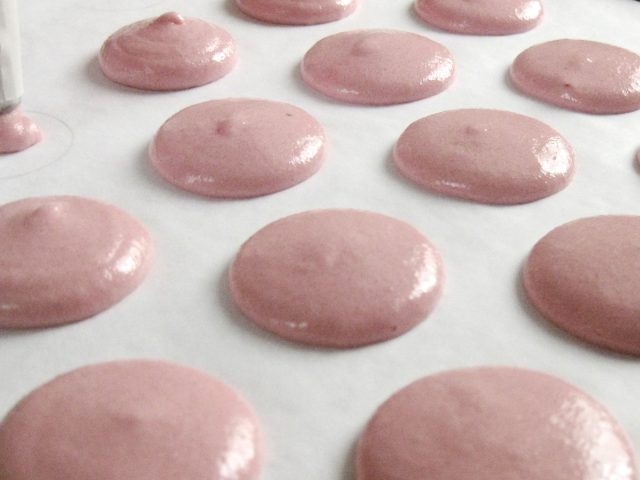
    When the disks are piped, the tips of the first macaron shell will be almost gone by the time you go to the second row. If you find that even after you finish the whole tray (20 or so) soft tips remain on the majority of the disks, the macaron shells are still okay: rap (hit or tap) the tray on the countertop and the tips should disappear. Such batter is still good batter and can produce good results. The macaron shells will flatten down a bit after rapping, but still hold their shape. The piped disks look sturdy, full and round as they sit to form a crust/skin.

Over-mixing

When the batter is over-mixed, the batter that has been put into the piping bag will flow out of the piping bag nozzle much faster than the perfect batter—so much so that when you flip the piping bag vertical to the baking sheet, you find that you have to be quick with your reflexes to flip the piping bag back up to stop the batter from flowing down. You will also find the action of piping round, even-sized circles difficult to control.

    After over-mixed batter is piped, the disks are flatter, thinner and more reflective in the light than good batter. It doesn’t hold its shape and eventually spreads out to irregular circles after a few minutes of resting. Sometimes, they even look like sad puddles of wet paint.

    Over-mixed batter will produce macarons that can come out looking somewhat like macarons. Feet can develop on the macarons when in the oven, but only very (very) slightly in height. It may remain at the end of the baking time after some shrinkage. The macaron shells can look smooth, but fragile.

Under-mixing

When the batter is under-mixed, the piped macaron shells do not flatten out as much and the tips remain. Under-mixed batter doesn’t spread out and remains as they were piped with the slight peaks still in place. It’s not so obvious when the batter is only slightly under-mixed as the tips do sink down and disappear after some time, but we notice that the disks look a little bulkier. When under-mixed batter still sinks down, you can usually tell that it is under-mixed by the paler colour of the macaron disks. The ability to distinguish under-mixed batter through the disks’ colour will require comparison with previous experience with seeing good piped batter, however.

    The image above appear to be a perfectly well-piped disk, but this image was captured after the batter has been sitting for 5 or so minutes. You can not tell by simply looking at this without a comparison, but this batter was much whiter than past uncoloured batter. It has not flattened down, peak is still visible and looks much bulkier than batter that is perfectly mixed.


Final Note

Ever since coming across macarons and this term ‘macaronnage’ and learning of its importance, we’ve taken the cautious route and tested the batter early, making sure the batter is of the right consistency and flowed right. We found that our frequent 30-second ribbon tests and attention to whether the batter sinks back in this time is what helped train us and our eyes to spot the correct batter consistency. We would suggest doing the same so that you learn to tell what the right consistency is without having to rely on the number of strokes. Doing this will give you just that little more control; you’ll be able to make big and small batches without worrying about how many strokes you need for the varying batch sizes you may want to make. If you use the 30-second test and check early, the line between perfectly-mixed and over-mixed batter will also not be as fine as many have stated.

    That is all for this installment. Our next section, we will be talking about Environmental Factors. Hope to see you back here soon!


See our other posts in Macarons, Quest for Perfection blog series:

1 comment for now